Welcome to Haiyani's English Writing Blog!!

You might find something you were looking for, but not always necessarily.

"I Am SHERlocked"

Recognize the quote above?

2013년 6월 3일 월요일

'The Tell-Tale Heart' and Gothic Literature

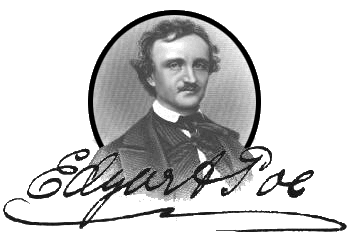
           We’ve all learned that ‘Gothic literature/novel’ (or genre of Gothic) is a mixture of mostly horror, thriller, mystery, science fiction, and Romantic. I found out that ‘Romantic’ novels (with a capital R) do not mean love stories but is a type of novel from Romanticism, and includes impractical/idealistic ideas. I also came to know that most of the short stories written by Edgar Allen Poe are Gothic. Especially, stories titled <The Black Cat> and <The Tell-Tale Heart> were the typical ones.
<The Tell-Tale Heart> is a story of a murderer who kills an old man for his hate towards his eye. While the old man was sleeping, this ‘mad man’ (who rejects being called that way) sneaks into the man’s room for 7 nights to make his actual murder perfect. From these, most of the readers feel frightened since the reason for his murder and the method are so unusual and it lies out of normal range of prediction. We often feel horrified when we get to know about ‘psychopaths’ around us since their thoughts are highly unpredictable, and they usually don’t show their madness until they actually commit crimes. I guess that’s the part where we feel horror, and where shows that this story falls into the category of Gothic.
The specific depiction of the man’s emotions is another part that makes us feel tension and horror. For example, the author illustrates the emotion and actions of the mad man when he was silently sneaking into the old man’s room in the darkness. The writer also shows specific emotions and thoughts of this man, and increases readers’ fear even more. This hits its peak at the last part of the story, where the man hears the old man's heart beating louder and louder.
Some might say this story contains mystery, but I thought this book can’t be a mystery. There is a chance of myself being wrong, but from my point of view, this story can never be mysterious about something. I can see that there are many scenes and elements that can be a mystery, but the point is, the murderer himself is the narrator. Since we already know who is the murderer, why and how he killed the victim and so on, there is no curiosity that can rise from this crime for the readers. Still, the overall atmosphere and the fear it is creating lets the story be a good example of Gothic literature.
To be honest, I didn’t enjoy reading it since the story was all about a murderer and his madness, so it couldn’t be a comfortable type of story to read. I don’t hate it though-I surely found out that it is not only scary and frightening, but is valuable from the aspects of literature as well.

How does the use of genre and writing style support the main ideas in George Orwell's 'Why I Write'?

              George Orwell was a writer who dealt with political issues and criticized undesirable form of governments in his novels, mostly in relation to the ones that existed at that time. ‘Why I Write’ is his autobiographical essay, which is mainly about answering two questions: ‘why’ and ‘how’ he writes.
Orwell recognizes that in nature, he would have been writing purple passages -sentences or expressions without specific meaning but rhetorical purpose only- and artistic, beautiful books without any political purposes. However, as he was living in the time when totalitarianism was hitting its peak, international relationships were worsening every day, and World War II was about to  take place, he felt responsibility to reveal the truth against the wrongs –especially political ones- done around the world. In short, he implies that he writes in order to let the general public acknowledge political injustice.
In the last paragraph, Orwell states how prose should be written (and how he tries to write), metaphorically, that “Good prose is like a windowpane.” Windowpanes are made up of glass and windowsills. Glass is transparent, symbolizing the place we see the world through. Windowsills are the ones that judge where the glasses will be placed. As writer’s political aspects differ from each others’, the windowsills will be placed differently. If all prose is like a windowpane, the readers will be able to see the world in diverse aspects from different angles. Therefore, the people will be able to remain objective, decide right or wrong themselves and eventually find out the injustice in the politics.
This piece of writing is a mixture of several different genres. First, this writing is an autobiographical essay. As the author writes about himself and his own thoughts, this essay is surely being autobiographical and expository. While in novels, authors must stand behind characters to convey messages and thoughts, usually in indirect ways, Orwell was enabled to write down his thoughts on why and how he writes freely and directly.
Second, this essay is being persuasive, since the author is giving out his opinion on which kind of prose is good. Since he is not being argumentative or against something, it is not a typical persuasive essay, but he is at least arguing that prose should never be lifeless but like a windowpane.
Poetry also comprises this writing. There is a poem in the middle of the essay, written by Orwell, which shows his struggle between writing style of his nature and style which the world wants him to write. The poem is being effective in conveying his struggle within short, symbolic words. Through this, readers could clearly see the reason why he writes right now. It also makes readers feel fresh to read poem inside a prose.
Orwell is being very dry and simple with his sentences in this essay. He tries to use rhetorical expressions or metaphors less as he writes. This makes the sentences look clean and clear, which helps him to convey exactly what he wants to. Being straightforward in meaning also shows that we are in emergency(when international tension has elevated) that we can’t be vague or misleading with our words.
Simple and clear sentences also let the whole essay be definitive. As people read this, they will feel that the writer is very confident and has no doubt on whatever he is writing about. This helps the essay to be more persuasive as he argues about how prose should be written.
Plus, this might be related to the fact that Orwell is viewing ‘purple passages’ negatively in this essay. In his young days, he once admired the literary value of those and wanted to be writing those later as they were producing joy and pleasure, making the sound rhythmical. However, he says they are ‘lifeless’ in the end since they are not helping the readers to see the world through a windowpane that the writers have made.
George Orwell’s essay ‘Why I Write’ is definitely a well-written essay as its genres; autobiographical, expository, persuasive and poetry; and its writing style, being dry and simple, benefit the intensity and delivery of the main points positively and effectively.
 

"The saddest string music ever composed"

Chaconne in G minor - Tomaso Antonio Vitali


          Chaconne in G minor composed by Vitali is considered one of the saddest classical musics. Chaconne initially means a piece of dancing music of Latin America. Europeans (especially Germans and Itailans) of the Baroque period developed this into a classical instrumental piece in three-quarter time music with deep, solemn melody.
         Performance of  Jascha Heifetz(1901-1987), also known as "the emperor of the violin", is considered the best of all (I will make a post about him soon :D), but the audio sound qualities are not as good as modern ones like this one. I will provide you with links to his performances in Heifetz post as well! This video contains music of Sarah Chang (Young-ju Chang), Korean famous violinist who is now a professor in Juliard.

Vitali's Chaconne is maximizing sorrow and heart-breaking pain through many variations of splendid melody of the string. Also, background bass sound from the orchestra is adding depth and grandiosity to the music.

I hope you enjoy this!

Turning June and did nothing.

          I started to feel an urgent need for me to manage my blog and post things.. I am almost the last person posting something other than class materials in my class.

          To be honest, I'm not really a good writer.. not a long writer either. (You can see this easily through my postings and essays on this blog)  My writing skills both lack in quailty and quantity! Ah, hopeless. I never lived abroad (especially English-speaking countries) or never learned basic English properly. I made no efforts to write and speak better English. I was simply lucky. Luck is what brought my English here.
          I always become reluctant to press the 'publish' button whenever I post essays on my blog... I realize there are so many eyes out there, ready to read my essays and giggle at my errors. I try to revise more but it doesn't work that well. Also my main reader has a pen and a paper to evaluate my writing skills and can directly report this on my student record paper. Whenever I tried to start writing something to post here, I felt like thrown naked in the middle of a group of lions, ready to chew and swallow me up. I had to make lame excuses to make myself stop writing "inevitably" and do something else.
          And 'Coding' thing? That was one of the biggest factors that stopped me from entering my blogger page. I didn't know anything about it, but just heard other people saying it is extremely complicated and hard for amateurs. This slowly generated fear inside me of coding and even feel guilty for not doing what Mr. Menard wanted us to do.
          So, it was about generally two things : sense of inferiority and fear towards 'coding'. This slowly generated some kind of 'fear' inside me of blogging which made me avoid writing in English and forget about my blog here. 'It's just too much for me', I thought.
          But then, I just thought : this won't make any difference in the end. No matter how much I feel pressure about the blog or how much I struggle, doing nothing will never improve my English writing nor will grant me a good grade in English class. That's when I started to think, 'I need to do something here.' Writing whatever I want to talk about might never help me improve, but it's going to better than nothing, right? So finally, I started searching for templates and blog designing strategies on the internet, and applied them to mine. And that was yesterday(June 2nd).
          And today, as I am writing free essays and putting efforts into blog designs, I am finding this somewhat interesting and fun! Coding was a bit complicated but wasn't that hard. I'm also counting on what Mr. Menard told our class : 'grammar (and vocabulary) will improve as you write more.' Fear did nothing good to me. Confronting directly into what I have to do and trying to get it done was the answer. Stopping makes no changes.
          Uhhh.. I lost point here. (Who cares..) So, in conclusion, what I truely wanted to tell you(whoever that is) is that I AM GOING TO POST THINGS 'FIERCELY' FROM TODAY!!
So be prepared to visit my blog and read, guys! Thank you! : )

Oh, and by the way, I'd like to thank Mr. Menard for conveying me such nice lesson above (while I'm not sure rather he will read this or not).

2013년 6월 2일 일요일

TOEFL Response #2 : A World Without Wires

         What would be the most annoying thing in the world? Well, there might be a variety of possible answers, but I am sure that one of them is electric wires of electronic devices. That’s why the word ‘wireless’ is considered very innovative and often used in advertisements. For instance, when we see wireless headphones or wireless televisions, we feel so new and fresh. However, I can definitely say that in the next 77 years, seeing devices with wires in normal days will become a rare experience for most people. 

        Generally, there are 2 uses of wires. First, wires are used when connecting two devices for informational exchanges. Wires of this use are decreasing day by day. For example, applying Wi-Fi technology to smartphones and laptops is letting people get rid of wires for LAN. Also, a few clever industries are putting this into their products such as printers. In the next few decades, Wi-Fi technology that can be applied to other kinds of devices will be developed, and will let all sorts of gadgets be connected to computers or smartphones. Users will be able to easily manipulate other devices around only if they can get access to them. For example, people will not need wires when using hard drives or USBs. Computers will be connected to big screens without wires, when giving presentations. 
Wi-Fi will enable connections without wires.
Moreover, air conditioners, washing machines and even lights can be connected by Wi-Fi to computers and work as a remote controller. The only problem with this is their higher costs. Wi-Fi available electronic devices will be more expensive than normal ones with wires as they would contain special signal receivers inside them. Therefore, if a new strategy to lower the cost of producing the receiver is found, this technology will soon be commercialized and put into common use.

    Second, people use wires when charging electronic devices by plugging them in the electric outlets. While many industries are interested in solving the first problem above, they usually consider wires for charging are inevitable. However, there is a brand-new technology that is being developed and published. Applying electromagnetic induction, gadgets that need no wires but a special device that induces electricity are being commercialized.
      Problem with this technology is that users need to put the gadgets on the device or else it will not be charged. Another technology that doesn’t even need this device is also being researched, but this is facing its hardship now since charging efficiency is much lower and its biological safety hasn’t been granted. However these small problems will definitely be fixed and will soon be available in markets. If this technology is combined with increased battery capacity, use of wires for charging will drop drastically.
 
           There are several possible benefits from drop of wire usage. Firstly, cost of initial resources will decrease, as massive amount of copper (and other metal resources in it) and rubber will be saved. Plus, air pollutants and CO2 produced when burning those will disappear as well. Lastly, people will get less annoyed as they do not need to make efforts or spend time in arranging screwed wires to be neat and clean.

      I’d like to conclude my essay with "equation of invention".

 
[People’s Want and Need + Technology ->
New Devices invented + Wires]

      Wires are often very useful and come in handy, but they are nothing more than a by-product of electronic devices that occurred in lack of technology. It’s time to eliminate unnecessary products that often disrupt the experiment from the equation as we have enough reactants to do so. The 21st century is here, and world with wires will soon withdraw.

2013년 5월 7일 화요일

Body Rituals among the Nacirema

The first thing I had in my head when Mr. Menard handed the class this essay: ‘Why?’ We all know he does not like TOEFL style writing and his classes are usually very unique. But why is he making us to write a review on a simple, TOEFL-like informative writing? The problem is, I stopped there. I ended up negotiating with my thought, thinking ‘maybe he is feeling a little tiresome today’ - which was a terrible mistake. I realized ‘the truth’ the next day.

<Body Rituals among the Nacirema> is an essay about unique rites practiced by the Nacirema people. The author illustrates their religious thoughts and rituals in informal sentences, and seems to be delivering the rites of an unknown, underdeveloped tribe. However, the Nacirema is actually ‘American’, written backwards – meaning that the writer was talking about Americans and their lives.

While it looks like an informative one, this essay is actually an experiment. In this piece of writing, the writer is conducting experiment on readers about how much we are vulnerable to stereotypes. He does this through fooling the readers by two different points as following.

The author uses clever language to convey the facts of American living style without implying that he is actually talking about America. He induces us to think of uncivilized tribes around the world by words such as ‘rituals’, ‘ceremonies’, ‘practitioners’, and ‘medicine men’. He connects the Nacirema with those. For instance, he says the Nacirema people ‘insert a small bundle of hog hairs into the mouth along with certain magical powders and move the bundle in a highly formalized series of gestures’, which is implying Americans brushing their teeth. By this skillful strategy, the writer succeeds in separating fixed thoughts, or stereotypes, that most of us have - American lives are civilized and fancy – from this essay. This enables the readers to freely think about how Americans live from objective point of view and judge its right or wrong. However, most of the readers end up thinking that the rituals of the Nacirema is very strange, weird and sometimes even inhumane. When they get to know that the Nacirema is in fact ‘Americans’, we feel shocked from the fact that while we were introduced of a familiar way of living, we are thinking in totally different way as we did towards Americans before reading this.

We often tend to believe in smart people. We believe that smart people make less mistakes and stay accurate, letting them to be more reliable – which is true in many cases. In the essay, the author uses many high-level, unfamiliar vocabularies that ‘sound’ smart to deceive the readers to think that the writer is also smart. Also, the writer gives specific facts such as ‘Professor Linton first brought the ritual of the Nacirema to the attention of anthropologists twenty years ago’, ‘they are a north American group living in the territory between the Canadian Cree, the Yaqui and …’, etc. These so-called ‘evidences’ are actually not true. These factors increase the reliability of readers towards the essay, thus readers feel there is almost no chance of being fooled by this essay. The writer uses this mentality to effectively fool them. This point also breaks people’s fixed idea that ‘smrt’ essays (with academic, professional terms) are highly reliable.
 

To conclude, I would like to relate the presence of stereotypes with the process of understanding cultures. As we have discussed above, there were generally two big fixed ideas in understanding cultures: we often see it based on stereotypes of their names (as we thought American culture as a fancy, developed one), and we are easily deceived by facts that look smart (or ‘smrt’). The writer is sending an important message to the readers: people should be alert and awake. By showing how the understanding of a culture can differ from each other depending on the existence of stereotype, the author is telling us that we should always be aware not to include or form fixed ideas or even prejudices in understanding foreign cultures. Also, we need to have an objective point of view to understand them fully and accurately.


Unconvinced?
Remember this picture!


2013년 4월 17일 수요일

Film Review (The Age of Stupid) - Two Things We Lack

      Just think of a big ship in the middle of a huge ocean, without any crew. No captain, no navigator, no maintenance personnel, and so on. The ship will drift on the water as wind pushes, and will hit somewhere and sink down before long. The time is ticking. There might be a rock nearby already. As passengers of the ship, what would you do? Wait, are you guys really passengers here?

      The Age of Stupid made me recall what I felt after watching An Inconvenient Truth years ago. I did enjoy it pretty much, but found a big problem in it. In the movie, Al Gore talks mostly about visible evidences of global warming, important facts related and how the governments can handle it--basically, everything. It does make you think deep and wide, but it is slightly not enough to alert the general public to change their actions since it is mainly delivering information. Many of us already know most of the facts he explains in the movie. We also know humans should take actions immediately to decelerate the temperature rise. However, there are only some around us who actually are concerned and actively participating to solve the problem. Why is this happening?

      From my perspective, that’s because WE LACK URGENCY. We have only been alleviating ourselves, saying “it’s going to be okay," “the doomsday isn’t going to come soon," and not facing the problem directly. From this view, The Age of Stupid can be a perfect complement for An Inconvenient Truth. In other words, this film works like a bright spark to light a big fire on our knowledge sleeping in our heads.


If you are not convinced why we need urgency or why we have to deal with global warming, this man might help you.


 To begin with, The Age of Stupid simply, scares us. Since the documentary is set in 2055 when the modern human society has already collapsed, the whole story starts from a negative point of view. The film shows that the apocalypse will take place 40 years later if the people don’t take global warming heavily and try to solve it actively.

“A war of biblical ferocity, across the whole continent!”

      The fear and tension of the film hits its peak when the numbers (2007 to 2055) show up on the screen, increasing in number and getting bigger and bigger in size. The sentence above is spoken when the number turns to 2055, the year that the apocalypse is thought to happen in the film. Surely frightening.

     
Plus, the film clearly states that we don’t have much time. Mark Lynas (environmental activist) was planning to decrease the amount of greenhouse gas emitted gradually for 7 years. However, the plan is already abortive, as 5 years have passed (2008-2013) without any fruitful decrease – the emission rather increased. According to a research done by International Energy Agency in 2011, the amount of carbon dioxide emitted in 2009 increased 18% in 2010. In order to prevent the temperature from increasing over 2℃ until 2020 (as governments have agreed to), 8~13Gt (1Gt = 10^9 metric tons) of greenhouse gas should be additionally reduced: which is almost impossible for now. In short, we have less time but more to do. The film is simply telling us that we have almost no time left until ‘the day’ comes.


      This documentary provides people with urgency and seriousness towards the problem effectively, and is persuasive enough to make changes in people’s minds to start taking actions to deal with global warming. This film isn’t perfect, though. The Age of Stupid lacks facts. It does not provide the viewers with enough background information related to global warming. Especially, the linkage between the apocalypse and global warming isn’t developed much. Although the film mentions it a little bit, further explanations about what will happen when global warming worsens were missing. People with less knowledge about this issue could have hard time understanding it thoroughly. Also, there is no clear relationship between such disasters to a sudden collapse of every country. I do agree that climate changes can cause massive destructions and deaths, but stretching it to the total apocalypse of mankind sounds like an exaggeration.

      There have been tons of different problems and issues around the world throughout the history of mankind. However, the problem we are facing right now is much different from them: because of not only its destructive result, but also its equal responsibility to everyone. None of us is especially responsible for it or free from being blamed, meaning that everyone must participate in solving this problem. What should we do then? Well, we already have the answers in ourselves. Save energy, consume things less, participate in NGOs. Don’t lose the urgency, and remember……
 
“There are no passengers on spaceship Earth. We are all crew.”


Canadian writer/philosopher